SKU: 21161140225
bugaboo stroller folding

bugaboo stroller folding Shop Bugaboo Kangaroo Tandem Stroller

Sale price$25.85 Regular price$28.72
Save 10%

Pay in installments of $7.18 with ShopPay, AfterPay and Klarna

Shipping Estimate
USA
  • USA
  • CAN

Ships within 48 hours · Estimated delivery Jul 21 - Jul 26

Promo Codes Available:

For Your Every Summer RSVP, with Code: SUMMER15

Description

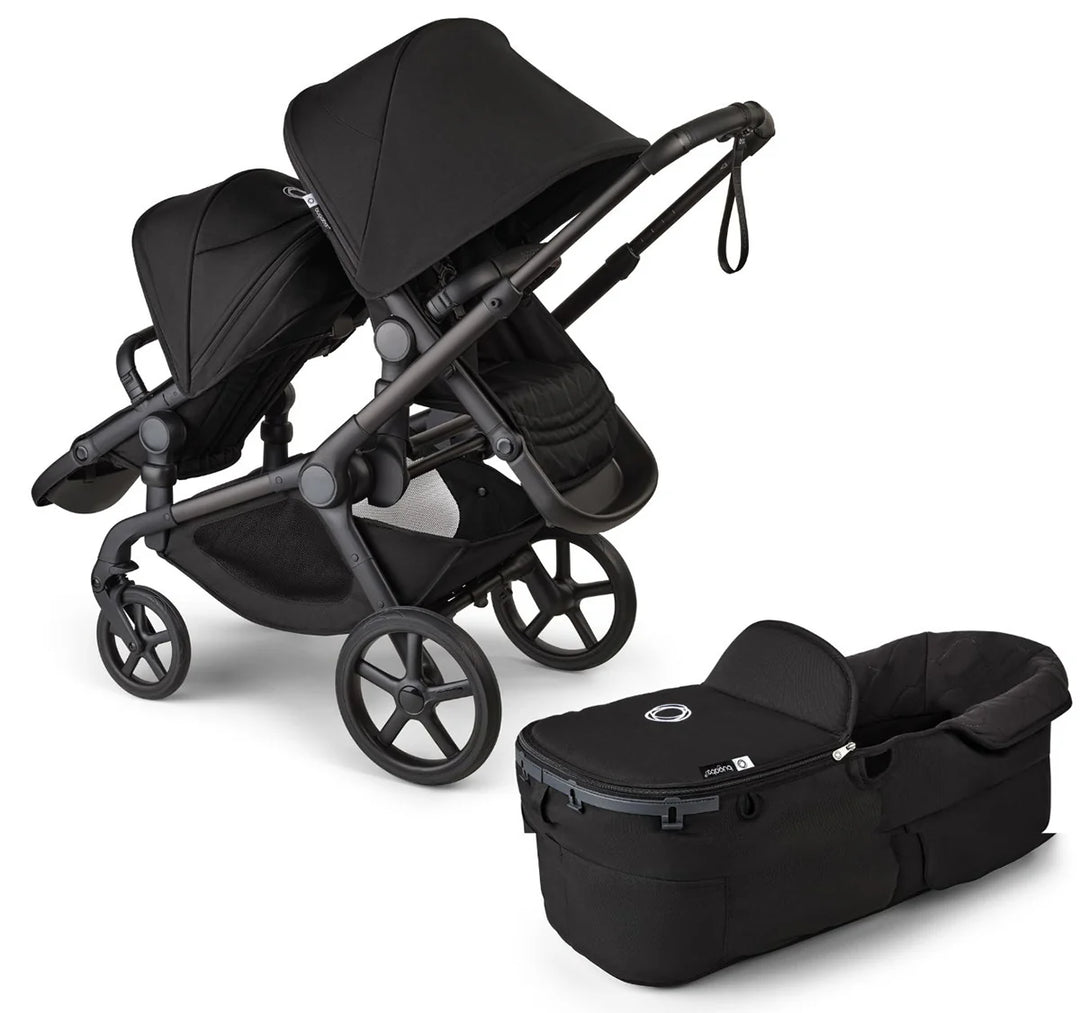
bugaboo stroller folding Shop Bugaboo Kangaroo Tandem StrollerKangaroo Tandem in short The go anywhere double stroller for one, two, or three kids. Engineered for ease, its quick to convert into the perfect set up for your family. It's the first ever tandem stroller made with eco friendly materials, reducing environmental impact by 16% so you can feel good about every stroll. Top Features XL wheels and optimal suspension system Fold, adjust, and maneuver with one hand Sibling seat carries up to 40 lbs (18 kg) XL

Kangaroo Tandem in short

The go-anywhere double stroller for one, two, or three kids. Engineered for ease, it’s quick to convert into the perfect set-up for your family. It's the first-ever tandem stroller made with eco-friendly materials, reducing environmental impact by 16% so you can feel good about every stroll.

Top Features


Sustainability

  • Built to last, tested beyond industry standards
  • Made with bio-based material for a lower environmental impact
  • Total CO2 footprint of 273 lbs (124 kg), a reduction of 16% to date
  • 100% vegetarian leather handlebar grips
  • Made in Bugaboo’s own Xiamen factory, under safe and fair conditions
  • Modular design supports repairs and refurbishment, if needed
  • Shipped from our factory with biofuels

What's in the Box?

Stroller base

The hardware for your Bugaboo Kangaroo. Includes chassis, wheels, wheel caps, and grips.

Main seat

Reversible and reclinable seat, with a reflective five-point comfort harness and adjustable seat footrest. Includes seat/bassinet frame, seat fabric, seat hardware, and rotating carry handle.

Bassinet fabric

With breezy panels for breathability and visibility which can be closed for warmth. Includes bassinet stiffener, bassinet bottom, and bassinet fabric set.

PureBreeze™ mattress

With dual sides for summer and winter. Featuring enhanced breathability and antibacterial technology for a healthy sleep environment.

Sun canopy

For main seat and bassinet. Extendable and height-adjustable, with UPF 50+ protection and a peek-a-boo panel. Includes wires and clamps.

Underseat basket

Main basket holds maximum 28.6 lbs (13 kg). Total capacity 18.4 gallons (70 L).

Car seat adapters

Compatible with Bugaboo Turtle Air Shield by Nuna and many infant car seats for a seamless transition between car and stroller. Check our Bugaboo Kangaroo car seat adapters page for a full compatibility list.

Sibling seat

Smaller seat for a second child. Reversible and reclinable, with a reflective comfort harness and adjustable footrest. Includes seat frame, seat hardware, rotating carry handle, and seat fabric. Includes lower adapters to install the sibling seat or bassinet in the lower position of the stroller.

Sibling sun canopy

For sibling seat. Extendable and height-adjustable, with UPF 50+ protection and a peek-a-boo panel. Includes wires and clamps.

Frequently Asked Questions (FAQs)

Q1: How do I fold the Bugaboo Kangaroo?

You can fold the Bugaboo Kangaroo exactly like you fold the Bugaboo Fox 5.

1. Activate the brake and lock the front wheels in the self-standing position.
2. Press the handlebar adjustment button (the bigger white button on the handlebar) and bring the handlebar to the lowest position (the last stripe on the inside of the aluminum tube).
3. Press both white buttons on the handlebar and push the handlebar in the direction of the tubes, so that the arrow on the inside of the aluminum tube is hidden.
4. Fold the stroller by pushing the handlebar down to the floor.
5. Lift up the center tube and bring the front and rear wheels together.
6. Put the stroller in the self-standing position. You're done.

Q2: How do I convert the Bugaboo Kangaroo from single to double Stroller? 

You can easily configure the Bugaboo Kangaroo to carry two children in a few easy steps:

1. Check that the stroller is in single mode (one-child indicator on the chassis is green).
2. Lift the clips to loosen the seat lugs.
3. Lift and reverse the seat lug bar.
4. Place the seat lug bar back into place.
5. Close the clips. The chassis is now in double mode (one-child indicator is red, two-children indicator is green).

Q3: How many different Seat configuration does the Bugaboo Kangaroo Have? 

When combined with dedicated accessories (all sold separately), the Bugaboo Kangaroo offers more than 20 versatile configurations in total. You can choose the perfect set-up for your family. If you only have one child, stroll with only a seat or a bassinet as you would with a single stroller. The seat is reversible and lets your toddler face you or face the world.

If you are strolling with two children, switch the Bugaboo Kangaroo to double mode by adding a Bugaboo sibling seat. Choose between riding with a bassinet and a seat, or two seats together. Both seats are reversible to offer options for a set-up that works for you. If you want to keep your newborn close by, add a Bugaboo Kangaroo upper newborn adapter to place the bassinet in the upper position. This way, your toddler can also take in the views from the front seat. Additionally, you can replace the bassinet with a compatible car seat if you want to transition your baby seamlessly from stroller to car and vice versa.

And if you want to bring a third kid along, add the Bugaboo comfort wheeled board to let them ride with the whole family.
A comprehensive list of recommended set-ups can be found in the Bugaboo Kangaroo's user guide.

Q4: What is the weight capacity of the Bugaboo Kangaroo?

The Bugaboo Kangaroo's bassinet carries your newborn from birth up to a maximum weight of 20 lbs (9 kg). The main seat can carry a toddler until they reach 50 lbs (22 kg), and the sibling seat carries up to 40 lbs (18 kg). The extra-large underseat basket's maximum load is 28.6 lbs (13 kg) to hold everything you need.

Q5: Are the main seat and the sibling Seat the same?

No, the sibling seat is a slightly smaller seat meant for a second child. It can carry up to 40 lbs (18 kg) when in the lower position, while the main seat is bigger and carries up to 50 lbs (22 kg). The sibling seat can be placed in the upper or lower position; this depends on whether you use it with the bassinet or the seat. The main seat, on the other hand, should only be used in the upper position.


Shipping Notes
  • Free Standard Shipping on $100+ Orders to the USA.
  • Except Preorder products are shipped in 48 hours.
  • Delivery to the USA:
  1. Standard Shipping : 3-10 business days
  • If time is of the essence, please consider selecting expedited delivery for faster service.
Exchange/Return Notes
  • We offer a 30-day return/exchange service after receiving.
  • Final sale items are not eligible for returns or exchanges.
  • To process your return/exchange, please contact us at [email protected]
  • Please click here for more details>>> Return & Exchange Policy
SKU: 21161140225

Discover Niche Categories That Outsell bugaboo stroller folding

Top-Converting Item to Boost Your Average Order

4.4 ★★★★★
Based on 18 reviews
Sort
Highest Rating
Newest First
Oldest First
Product Reviews
C
Verified Purchase
Chris Morton
Phoenix, US
★★★★★ 5
Excellent!!!
Format: Kindle
A wonderfully refreshing argument for "the living constitution". Most surprisingly is that much of the argument is based in the philosophy of Edmund Burke, father of modern conservatism.
WAS THIS REVIEW HELPFUL?YesReportShare
Reviewed in the United States on February 22, 2017
M
Verified Purchase
Matt Cockerill
Phoenix, US
★★★★★ 5
Five Stars
Format: Hardcover
Strauss demolishes originalism in a concise and accessible volume.
WAS THIS REVIEW HELPFUL?YesReportShare
Reviewed in the United States on November 11, 2014
S
Verified Purchase
Stephen J. Jaros
Birmingham, US
★★★★★ 3
Ultimately disappointing .. but still a good read
Format: Hardcover
This book does have a few commendable features. It is written in laymen's language, you don't have to be a constitutional law scholar like David A. Strauss to comprehend the arguments. And it's short. Won't take more than a couple of hours to read. But as a critique of the "originalist" constitutional doctrine, it is hit and miss. For example, Strauss argues that originalism has three major flaws (p.18): 1) the impossibility of determining what the understanding of the founding fathers was on a particular issue. 2) the impossibility of translating an original understanding so that it addresses today's problems. 3) no answer for Thomas Jefferson's question about why we, the living, should be governed by the "dead hand" of past generations, including the founders. Of these three, the first is the most telling, because it is indeed sometimes the case that we do not know what the founders would have thought about a particular issue, because that issue simply did not exist at the time of the enactment of the constitution or a particular amendment, or because that original meaning could be lost to history. The patent-ability of new life forms as a result of genetic engineering being a good example (but, other technological examples, like cases related to airplanes and cars, are NOT good examples, since while the founders were unaware of these technological advances, it's safe to assume they would recognize them as transportation vehicles, so their understanding of ships and horse carriages would apply to them). That's why i am what Strauss might call a "sometimes originalist" - my view is that IF there is no reasonable doubt about what the enactors of a constitutional provision would have thought about a case, then that should control the decision a court arrives at. But obviously, if the issue was unknown to the enactors, or if their views are forever lost to us due to the passage of time, then there is no "original understanding" of that particular issue, and some other method of constitutional interpretation must be relied on. The second and third objections are far less compelling to me. The second objection is IMO a non-issue. To ask "well, we know that in 1880 the enactors of the 14th amendment did not believe its equal protection clause outlawed employment discrimination against women, but would they believe that if they were living in the year 2000, with all the economic/cultural/technological changes that have developed over those 120 years?" is an irrelevant question. It's like asking if the 1969 Congress that enacted the Clean Air Act would still enact it if that Congress were to debate the issue in 2010: it's purely speculative and ungermane, since neither statutes nor constitutional provisions have expiration dates on them. Likewise, the 3rd objection is both shallow and disingenuous. Shallow because Jefferson clearly understood that the constitution, like laws enacted by the legislature, are subject to change by later generations, who can amend the constitution or pass new legislation to supersede what previous generations have accomplished. Disingenuous, because the invocation of Jefferson seems to be a tactical decision by Strauss, a way to tweak originalists by citing one of the very greatest of our founding fathers. Yet Jefferson can also be quoted to support an originalist view. For example, in 1801 he said: "The Constitution on which our union rests, shall be administered by me according to the safe and honest meaning contemplated by the plain understanding of the people of the United States, at the time of its adoption....These explanations are preserved in the publications of the time, and are too recent in the memories of most men to admit of question." (Writings of Thomas Jefferson, quoted from a letter dated 3/27/1801). The first part of this quote clearly indicates that Jefferson believed that constitutional provisions should be interpreted according to original understanding, not "modern, evolved" standards of meaning as David Strauss would contend. The second part speaks to the need i identified before, that of knowing within the bounds of reasonable doubt what the enactors understood a provision to mean. Beyond all this, though, is David Strauss's contention that a "living constitution", as defined by a common-law like accretion of judicial precedent in constitutional matters that leave the original meaning of the text behind, is necessary because otherwise our constitution would become an archaic relic unable to meet the demands of a changing society, and that the formal amendment process is too slow and cumbersome. Professor Strauss correctly notes that Jefferson believed that our institutions must evolve with the development of society; however, he crucially fails to note that to Jefferson, the primary mechanism of such innovation was to be the actions of the legislature. Constitutional provisions are expounded in broad, general language not to enable future judges to interpret them in light of changing societal conditions, but to permit elected bodies, like legislatures and congress, wide latitude to address the problems of today. Legislative bodies, which directly reflect the ebbs and flows of societal change and are accountable to the people, were Jefferson's preferred vehicle of constitutional innovation, not the decisions of insulated, life-tenured court judges. On this point, unlike on many others, Jefferson was in agreement with John Marshall. As Jean Edward Smith (1996) writes "When (in McCulloch v. Maryland) Marshall spoke of the Constitution as "intended for ages to come" and of the need to adapt it "to the various crises of human affairs", he was alluding to the responsibility of Congress, not the Court. And the limits on Congress were defined by the political process, not the judiciary" (p. 445). Thus, for example, while the enactors of the 14th amendment did not intend for it to ban employment discrimination against women, it also was not intended to prevent Congress or the state legislatures, at the time of the enactment or in the future, from enacting legislation that does protect women from employment discrimination should that type of legislation be deemed necessary or advisable. Jefferson was far more wary of "innovative" actions by judges, exemplified by his belief that "if federal judges have the final word over its meaning, the Constitution would be a mere thing of wax in the hands of the judiciary, which they may twist and shape into any form they please". Yet it is exactly this type of judicial activism that Strauss means when advocates a "living constitution". Strauss's fundamental error is revealed on page 103 when he says that "We cannot say that the text of the constitution does not matter ... no (textual) provision of the constitution can be overruled in the way a precedent can, or disregarded the way original understandings often are". What Strauss is saying here (well, he wouldn't put it this way, but this is my view of the matter) is that when a judge wants to be activist, to impose his/her personal policy preferences on a case, it's very important that the judge somehow, through clever verbal gymnastics, no matter how convoluted, "ground" that ruling in some actual constitutional-textual language. This is very important for achieving the political purpose of maintaining respect for the court in the eyes of the public. But to me, Strauss creates a false dichotomy: The text of the constitution is ONE AND THE SAME with its "original understanding". The 'text', the actual words of the constitution, does not exist independent of the original understanding of those words, the text is merely the communicative vessel used to convey that original understanding. That's the way language works. It's a method to convey meaning. Thus, to invoke the Due Process Clause of the 5th amendment to outlaw Federal segregation laws (as the Court did in 1955) when the enactors of the 5th amendment clearly (as Strauss admits) did not intend for it to mean that, is the SAME THING as ignoring the "text" of the constitution, since the text and original understanding are one and the same. Overall, i recommend this book. One will learn alot about constitutional history, and Professor Strauss is surely correct in that the "living constitution" view is in fact the dominant way in which the Court has gone about its business in practice, regardless of what legal theoreticians have thought. But, don't expect to be convinced by much Professor Strauss has to say about why this is a good thing.
WAS THIS REVIEW HELPFUL?YesReportShare
Reviewed in the United States on May 18, 2010
R
Ross L. Meyer
Cuba, US
★★★★★ 5
Originalist v Living Document , 5 - 4
Format: Hardcover
I found the author's arguments to be logical and compelling. Those who embrace the so-called originalist view of the Constitution, for example Supreme Court Justice Antonin Scalia, claim that they know - with great certainty - the absolute intent of the Constitution's authors. Further they claim that the Constitution provides specifics and principles which of course it does. It is simple to understand the specifics, but what about the principles? Principles, it seems to me, can and do have differing interpretations. One of the definitions of the word principle found in Merriam-Webster states, "a moral rule or belief that helps you know what is right and wrong and that influences your actions." As we all know, rules and beliefs frequently mean different things to different people. If it were not so, Supreme Court decisions would inevitably be decided 9 - 0. Many are familiar with the Supreme Court's case District of Columbia v. Heller in which Justice Scalia opined that the Second Amendment shouldn't stop the U.S. from barring certain weapons. While his opinion certainly seems reasonable to me, I cannot find that principle in the Constitution. Rather it seems to be a logical conclusion based on modern society, mores, and laws - perhaps, as Professor Strauss argues, Common Law. Whether one accepts the originalist view of the Constitution or, as I, believes a living interpretation of the great document is preferable, the one thing we can all agree on is that our nation is one of laws. To that end, it is incumbent on all citizens to accept and abide by the pronouncements of our judges, agree with them or not.
WAS THIS REVIEW HELPFUL?YesReportShare
Reviewed in the United States on November 18, 2014
B
Verified Purchase
Brenda B.
Draper, US
★★★★★ 5
My Grandchildren LOVED this!
Format: Hardcover
I read this out loud to my two grandchildren ages 4 and 6 at bedtime. They're so excited to be reading a chapter book and they LOVED it! The book's quirky sense of humor is great and it was fun to hear the kids giggle. We loved how the sloth appears in each story. They couldn't wait for the next night to read. Mr Angleberger- please write more!!!
WAS THIS REVIEW HELPFUL?YesReportShare
Reviewed in the United States on October 24, 2017

recommand products